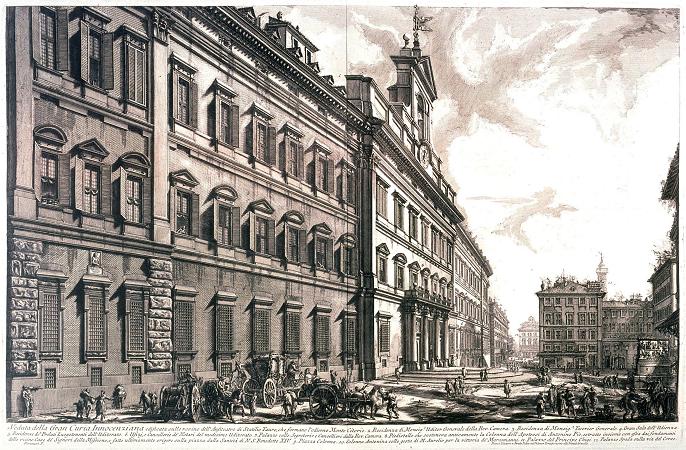
Palazzo Montecitorio. The Palazzo Montecitorio is a palace in Rome and the seat of the Italian Chamber of Deputies.
The palace's name derives from the slight hill on which it is built, which was claimed to be the Mons Citatorius, the hill created in the process of clearing the Campus Martius in Roman times. The building was originally designed by Gian Lorenzo Bernini for the young Cardinal Ludovico Ludovisi, nephew of Pope Gregory XV. However, with the death of Gregory XV by 1623, work stopped, and was not restarted until the papacy of Pope Innocent XII, when it was completed by the architect Carlo Fontana, who modified Bernini's plan with the addition of a bell gable above the main entrance.
The building was designated for public and social functions only, due to Innocent XII's firm anti nepotism policies which were in contrast to his predecessors. In 1696 the Curia apostolica was installed there.
Later it was home to the Governatorato di Roma and the police headquarters. The excavated obelisk of the Solarium Augusti, now known as the Obelisk of Montecitorio, was installed in front of the palace by Pius VI in 1789.
With the Unification of Italy in 1861 and the transfer of the capital to Rome in 1870, Montecitorio was seized by the Italian government and chosen as the seat of the Chamber of Deputies, after consideration of various possibilities. The former internal courtyard was roofed over and conv
The palace's name derives from the slight hill on which it is built, which was claimed to be the Mons Citatorius, the hill created in the process of clearing the Campus Martius in Roman times. The building was originally designed by Gian Lorenzo Bernini for the young Cardinal Ludovico Ludovisi, nephew of Pope Gregory XV. However, with the death of Gregory XV by 1623, work stopped, and was not restarted until the papacy of Pope Innocent XII, when it was completed by the architect Carlo Fontana, who modified Bernini's plan with the addition of a bell gable above the main entrance.
The building was designated for public and social functions only, due to Innocent XII's firm anti nepotism policies which were in contrast to his predecessors. In 1696 the Curia apostolica was installed there.
Later it was home to the Governatorato di Roma and the police headquarters. The excavated obelisk of the Solarium Augusti, now known as the Obelisk of Montecitorio, was installed in front of the palace by Pius VI in 1789.
With the Unification of Italy in 1861 and the transfer of the capital to Rome in 1870, Montecitorio was seized by the Italian government and chosen as the seat of the Chamber of Deputies, after consideration of various possibilities. The former internal courtyard was roofed over and conv
Wikipedia ...